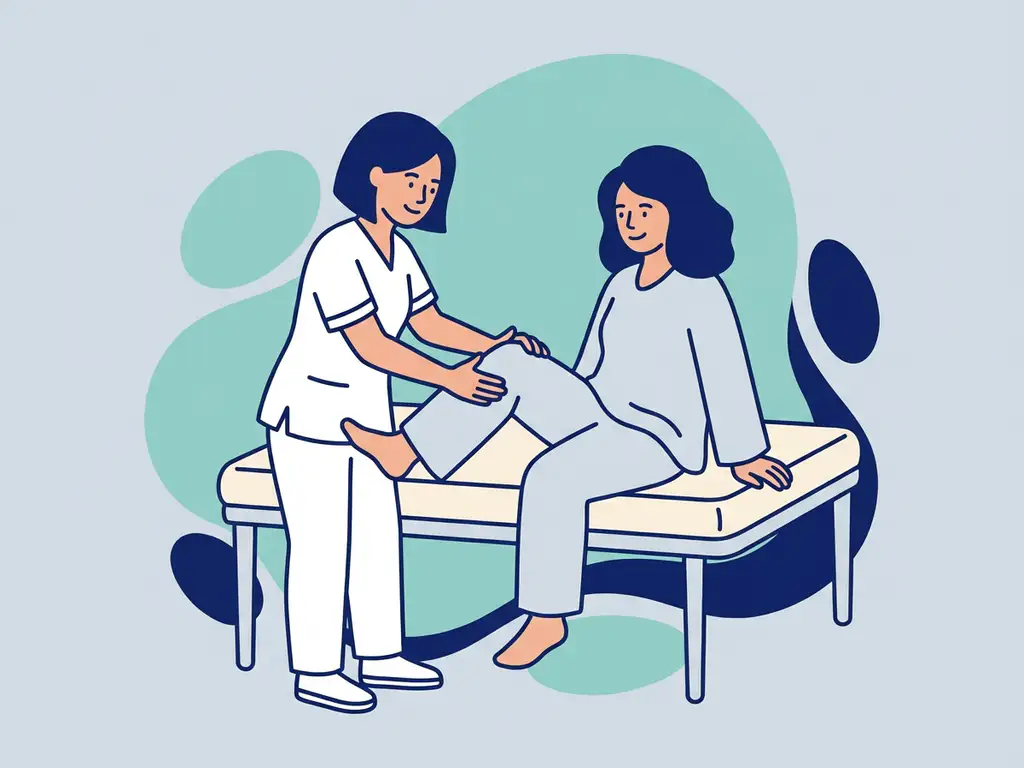
Mensen met knieartrose in de regio Eindhoven kunnen actief blijven door gericht te bewegen, de belastbaarheid van het kniegewricht stap voor stap op te bouwen en begeleiding te zoeken bij een gespecialiseerde fysiotherapeut. Bewegen is juist bij artrose geen risico, maar een noodzaak: het houdt het kraakbeen gevoed, versterkt de omliggende spieren en vermindert pijn op de lange termijn. De vragen hieronder geven je een helder beeld van wat werkt, wanneer je actie moet ondernemen en hoe fysiotherapie het verschil maakt.
What exercises help most with knee osteoarthritis?
The most effective exercises for knee osteoarthritis are low-impact, strength-building movements that support the joint without overloading it. Quadriceps strengthening, hip abductor training, and controlled cycling or walking are among the most evidence-supported options. These exercises reduce pressure on the knee, improve joint stability, and help manage pain over time.
Strength training is particularly important because the muscles around the knee act as natural shock absorbers. When these muscles are weak, the joint itself absorbs more impact with every step, accelerating wear and increasing discomfort. Exercises like seated leg presses, straight-leg raises, and step-ups are often recommended because they build strength progressively without placing excessive stress on the cartilage.
Aquatic exercises and cycling are also highly effective for people who find weight-bearing movements painful in the early stages. These activities allow the body to build fitness and muscle tone while reducing the mechanical load on the knee. As strength and tolerance improve, more varied and demanding exercises can be introduced gradually.
The key principle is consistency over intensity. Short, regular sessions are far more beneficial than occasional high-effort workouts. A physiotherapist can help determine which exercises are appropriate for your specific stage of osteoarthritis and adjust the program as your capacity grows.
How does physiotherapy reduce knee osteoarthritis pain?
Physiotherapy reduces knee osteoarthritis pain primarily by increasing the load capacity of the joint and surrounding tissues. Through targeted exercise, manual therapy, and education, physiotherapy addresses the underlying physical causes of pain rather than simply masking symptoms. The result is less pain during daily activities and greater confidence in movement.
One of the core mechanisms is muscle strengthening. When the muscles around the knee become stronger, they absorb more of the forces generated during walking, stair climbing, and other daily tasks. This reduces the strain placed directly on the joint, which in turn lowers pain levels over time.
Physiotherapy also addresses movement patterns. Many people with knee osteoarthritis unconsciously adapt how they walk or stand to avoid pain, which can create imbalances elsewhere in the body. A physiotherapist identifies these compensations and works to correct them, preventing secondary complaints from developing in the hips, back, or opposite knee.
Education plays an equally important role. Understanding what is actually happening in the knee, which movements are safe, and how to manage flare-ups gives patients a sense of control that reduces the fear and tension that often amplify pain. Knowledge is a genuine pain management tool.
What’s the difference between physiotherapy and exercise therapy for knee osteoarthritis?
Physiotherapy is a broad discipline that includes assessment, manual treatment, education, and exercise guidance, while exercise therapy is a specific component focused on structured physical training to improve strength, mobility, and function. For knee osteoarthritis, both are valuable, and they are often combined within a single treatment program.
Physiotherapy typically begins with a thorough assessment of the patient’s complaints, movement patterns, and physical capacity. Based on this, a physiotherapist may use hands-on techniques such as joint mobilization or soft tissue work alongside exercise prescription. The approach is personalized and responsive to how the patient progresses.
Exercise therapy, sometimes delivered in a group or supervised gym setting, focuses specifically on building physical capacity through progressive training. It is particularly effective in the later stages of a treatment program, when the patient has enough foundational strength and understanding to train more independently under supervision.
For most people with knee osteoarthritis, the two approaches complement each other well. Physiotherapy provides the diagnostic foundation and hands-on support, while exercise therapy builds the physical resilience needed for long-term symptom management and an active lifestyle.
Should you rest or keep moving with knee osteoarthritis?
You should keep moving with knee osteoarthritis. Rest may feel like the logical response to joint pain, but prolonged inactivity weakens the muscles that support the knee, reduces cartilage nutrition, and often makes pain worse over time. Controlled, appropriate movement is one of the most effective tools for managing osteoarthritis symptoms.
This does not mean pushing through severe pain or ignoring your body’s signals. There is an important distinction between the discomfort that comes with rebuilding strength and the sharp pain that signals overload. A physiotherapist can help you find the right balance, gradually increasing activity in a way that challenges the joint without damaging it.
Short periods of rest after demanding activities are entirely appropriate, especially during flare-ups. The goal is not to exercise through acute pain but to maintain a baseline level of activity that keeps the joint mobile and the surrounding muscles engaged. Even gentle daily walking contributes meaningfully to joint health.
The broader principle is that the knee adapts to the demands placed on it. Consistent, progressive loading encourages the body to become stronger and more resilient. Avoiding movement does the opposite, creating a cycle of weakness and increasing pain that becomes harder to break over time.
When should someone with knee osteoarthritis see a physiotherapist?
Someone with knee osteoarthritis should see a physiotherapist as soon as daily activities become limited or painful, rather than waiting until symptoms become severe. Early intervention allows for a more gradual and effective build-up of strength and mobility, and it prevents the development of compensatory movement patterns that can cause additional problems.
Common signs that professional guidance is needed include persistent stiffness after rest, pain when climbing stairs or rising from a chair, swelling around the knee after activity, or a noticeable reduction in the distance you can walk comfortably. These are not inevitable parts of aging that must be accepted, but signals that the joint needs targeted support.
It is also worth seeking physiotherapy before and after a knee replacement if surgery is being considered. Preoperative physiotherapy strengthens the muscles around the joint and improves overall fitness, which research consistently links to better surgical outcomes and faster recovery. Postoperative physiotherapy then guides the rehabilitation process and helps patients regain full function safely.
Waiting until pain becomes unbearable or function is severely limited makes the recovery process longer and more complex. The earlier a specialist assesses your situation and builds a personalized plan, the better your prospects for staying active and independent.
Hoe Vief Leven helpt bij knieartrose
Vief Leven is een gespecialiseerde fysiotherapiepraktijk in Tilburg, specifiek gericht op mensen met heup- en knieartrose. Of je nu in Tilburg woont of bereid bent te reizen vanuit de regio Eindhoven, Vief Leven biedt een persoonlijke aanpak die aansluit bij jouw klachten, doelen en tempo. Wat Vief Leven onderscheidt:
- De Vief Methode: een driestappenaanpak die begint met een persoonlijk behandelplan, gevolgd door gerichte informatie over jouw situatie, en vervolgens activatie van het lichaam via oefentherapie om de belastbaarheid van de knie te verhogen.
- State-of-the-art trainingsapparatuur: geavanceerde luchtdruktechnologie maakt op maat gemaakte trainingsschema’s mogelijk, met continue monitoring van voortgang en snelle bijsturing waar nodig.
- De Vitaliteitsclub: een unieke omgeving waar mensen met artrose veilig en effectief kunnen trainen onder begeleiding van specialisten.
- Begeleiding rondom operaties: zowel preoperatieve voorbereiding als postoperatieve revalidatie, inclusief fysiotherapie aan huis in de eerste herstelfase.
- Persoonlijke aanpak: geen standaardprogramma’s, maar behandeling die continu wordt aangepast op basis van jouw voortgang en behoeften.
Wil je weten wat Vief Leven voor jou kan betekenen bij knieartrose? Neem vandaag nog contact op en maak een afspraak voor een persoonlijk kennismakingsgesprek. Samen werken we aan meer bewegingsvrijheid en een actiever leven.
Veelgestelde vragen
How long does it take to notice improvement from physiotherapy for knee osteoarthritis?
Most people begin to notice meaningful improvements in pain and function within 6 to 12 weeks of consistent physiotherapy, though this varies depending on the severity of the osteoarthritis and how regularly the program is followed. Early gains often come in the form of reduced stiffness and greater confidence in movement, while strength improvements tend to build more gradually over months. The key is maintaining consistency between sessions, as the exercises done at home are just as important as the guided sessions with your physiotherapist.
Can I continue physiotherapy exercises at home, and how do I know I'm doing them correctly?
Yes, home exercise is a core part of any effective knee osteoarthritis program, and your physiotherapist should provide you with a clear, written or video-guided routine tailored to your current capacity. To ensure correct technique, ask your physiotherapist to observe and correct your form during sessions before you practice independently. If you experience sharp pain, swelling, or significant discomfort during a home exercise, stop and report it at your next appointment so the program can be adjusted accordingly.
Is it safe to exercise during a flare-up of knee osteoarthritis?
During a flare-up, it is generally best to temporarily reduce the intensity and volume of exercise rather than stopping completely. Gentle, low-impact movements such as short walks, seated range-of-motion exercises, or light cycling can help maintain joint mobility without aggravating the inflammation. Your physiotherapist can guide you on which exercises to scale back and which to continue, so you stay active without prolonging the flare-up.
What lifestyle changes beyond exercise can support knee osteoarthritis management?
Weight management is one of the most impactful lifestyle factors, as each kilogram of body weight adds roughly three to four kilograms of force on the knee joint during walking. Prioritizing good sleep, managing stress, and following an anti-inflammatory diet rich in vegetables, healthy fats, and lean protein can also support recovery and reduce overall pain sensitivity. These changes work best when combined with a structured physiotherapy program, rather than as standalone solutions.
What common mistakes should I avoid when starting an exercise program for knee osteoarthritis?
The most common mistake is doing too much too soon, which can trigger a flare-up and discourage continued effort. Starting with low resistance and short durations, then progressing gradually, is far more effective than high-intensity sessions that leave the knee swollen and painful the next day. Another frequent error is skipping the warm-up or stopping exercise entirely after a bad day, rather than adjusting the load and continuing at a lower level.
Will physiotherapy prevent me from needing knee replacement surgery?
Physiotherapy cannot reverse cartilage damage, but strong evidence shows that a well-structured program can significantly delay or even eliminate the need for surgery in many patients by reducing pain and improving function to an acceptable level. Studies suggest that a substantial proportion of people who are initially referred for knee replacement experience sufficient improvement through physiotherapy and exercise that they choose to postpone or forgo surgery altogether. Even for those who do proceed with surgery, physiotherapy beforehand leads to better outcomes and faster recovery afterward.
How do I find the right physiotherapist for knee osteoarthritis, and what should I look for?
Look for a physiotherapist who specializes in musculoskeletal conditions and has specific experience treating osteoarthritis, as not all physiotherapy practices focus equally on this area. During your first appointment, a good specialist will conduct a thorough assessment of your movement, strength, and daily limitations before recommending any treatment, rather than applying a generic protocol. It is also worth asking whether the practice offers exercise therapy alongside hands-on treatment, as the combination of both approaches tends to produce the best long-term results for knee osteoarthritis.